Conservation of a Papyrus Roll with No Glass Frames

Some of the real workhorses of both my teaching and public presentations over the years have been a group of papyrus rolls in Berlin. They are a set of Greek documentary rolls from the second half of the second century CE that were bought in 1912 in an excellent state of preservation.

I use images of these manuscripts to provide illustrations of the papyrus roll as a three-dimensional object and also to show the differences between literary rolls, with their (usually) narrow columns and neat scripts, and these everyday documents with their broad columns and cursive writing.

For many years, I used an image of the roll that was found in the wonderful old journal, Jahrbuch der Einbandkunst (an image that also appears in lower resolution in the second edition of Schubart’s Das Buch, p. 53, fig. 14–so the photo must have been taken before 1921).

A well preserved papyrus roll (P.Berol. inv. 11651); image source: Jahrbuch er Einbandkunst 1937

More recently I’ve used color images from the public display of one of the rolls in the Ägyptisches Museum in Berlin:

Another well preserved papyrus roll (P.Berol. inv. 11642); image source: Brent Nongbri 2025

I’ve often thought that these rolls have held up remarkably well for being 2000-year old artifacts. But of course, nobody looks that good at that age without having a little work done.

Today I stumbled across a very interesting article that describes the process of conserving these rolls–“die Methode der doppelseitigen Chiffonierung,” double-sided application of a fine silk to hold the roll together, a practice championed by Rolf Ibscher (1906-1967), book conservator and son of the famous conservator, Hugo Ibscher (1874-1943) The roll described in the article is P.Berol. inv. 11651 (the one in the black and white image above), and the same process was applied to 11642, the roll in the color image above. The process has several steps.

First the roll was cut into pieces to make it more manageable, and damaged areas were repaired with Japanese paper in order to “eliminate the distracting gaps” in the papyrus. Then these papyrus and paper portions were dampened and flattened. A strip of plastic film was laid out and coated with rice starch (there is no mention of moistening the starch, but I imagine it must have been a thin paste). Then the silk mesh was placed on the rice starch to absorb it and be stretched to the proper level of tension. The plastic film was then used as a kind of applicator to press the silk and starch on to the dampened papyrus pieces. Once the silk was firmly attached to the papyrus, the plastic film was peeled away.

The process was then repeated on the other side of the papyrus sheets. All the parts were pressed for 24 hours until the all the material was dry. And then the gap-free, newly flexible roll was ready to go.

P.Berol. inv. 11651 after conservation; image source: Wolfgang Müller, Rolf Ibscher and Otto Werner Luke, “Zur Chiffonierung der Papyrusrolle P. 11651,” Forschungen und Berichte 6 (1964) 97-101.

While the papyrus may now be gap-free, there are a few gaps in the narrative. There is no discussion of how the cut up pieces of papyrus were reattached to one another. Nor is there any discussion of the degree to which the silk obscures physical features of the rolls like kolleseis (the ancient joins between sheets). But on the whole, it’s very nice to have this documentation of the conservation process. There are definite benefits to cutting rolls and mounting them between glass plates to make them easily (and safely) readable–see the fine images of P.Berol. inv. 11656, another papyrus roll purchased in 1912 that has been flattened. Yet, I can’t help feeling that it’s nice to have a few examples conserved in ways like this that help us to appreciate the three-dimensionality of these artifacts. But of course I may be biased here because I am not a specialist in the texts preserved on these rolls and will likely never need to consult them to check readings. I am not thrilled that a similar procedure was carried out on the bifolia of an important papyrus codex in a way that has rendered close study of the papyrus surface difficult, if not impossible. But these kinds of decisions always have benefits and drawbacks. And as I said, it’s very good to have even this little bit of documentation of a papyrus conservation process from the middle of the twentieth century.

Source: Wolfgang Müller, Rolf Ibscher and Otto Werner Luke, “Zur Chiffonierung der Papyrusrolle P. 11651,” Forschungen und Berichte 6 (1964) 97-101.

Posted in Voluminology | Tagged , , , , | Leave a comment

The Provenance and Date of the Berlin Cretans

One of the reference points that used to come up very frequently in discussions of the earliest codices was a manuscript of Euripides–the Berlin Cretans, an isolated parchment folium that was published in 1907 as BKT V.2 XVII (P.Berol. inv. 13217).

The original editors, Wilhelm Schubart and Ulrich von Wilamowitz-Moellendorff, assigned the script of the leaf to the first century CE, instantly making it the earliest surviving codex. The difficulty, however, was that they presented no securely dated parallel to make their dating convincing.

Plate accompanying the publication of the Berlin Cretans showing the two sides of the folium; image source: BKT V.2

In his classic book The Typology of the Early Codex (1977), Eric Turner devoted an appendix to trying to establish a more well-grounded date for this manuscript. Turner classified the script as a sloping variety of his “formal mixed” type and opted for a significantly later date in “the latter half of c. ii A.D. (c. A.D. 150-200).” Guglielmo Cavallo also weighed in on the question in 1985, expressing a preference for a date squarely in the third century (“La nascita del codice,” p. 120).

Absent in any of this discussion was the provenance of the folium. The original editors of the Cretans leaf did not, in 1907, mention anything about its origins. A lack of interest in such questions was not uncommon in those days. But in 1974, when Herwig Maehler published a large group of papyri in Berlin excavated under the direction of Otto Rubensohn at Hermopolis in the early twentieth century, he pointed out that Rubensohn’s notes contained short descriptions of the manuscript finds from the site.1 On 27 January 1905, several interesting finds are mentioned, including 40 complete documents and a parchment leaf from an octavo book.2 Maehler then made reference to a short 1905 article by Ludwig Borchardt, in which he reported briefly on the 1905 season at Hermopolis:

“Work for the Prussian Papyrus Expedition initially took place in Ashmunein [ancient Hermopolis], specifically in the eastern part of the town. Here, a large number—about 150 pieces—of complete business documents from the third and fourth centuries and a number—about 20 fragments—of literary works were found. Among the latter were several larger pieces from a codex of Homer dating from the 4th or 5th century and a parchment sheet containing 56 verses from Euripides’ Cretans.”3

As Maehler recognized, the parchment leaf found with the group of documents on the 27th of January must be the Berlin Cretans, which has 26 lines on each page, for a total of 52 verses. So, this parchment folium actually does have an archaeological context. It was found in the same location–on the same day–as a documentary archive. The easiest explanation is that the literary piece was thrown out at the same time as the archive.

What is more, subsequent study of the 40 complete documents revealed that they were in fact the archive of Flavius Taurinos containing items dating from 426 to 513 CE. That is to say, this parchment leaf was found in some kind of proximity to documents discarded in the sixth century. It is possible that this folium was a survival from a codex produced centuries earlier and saved with this collection. This was in fact what Maehler proposed in a later article:

“Given the circumstances of its discovery, it seems highly likely to me that [the Berlin Cretans] was part of these family archives. The style of the handwriting suggests a date towards the end of the second or, I believe, the beginning of the third century. The folio is damaged in the center but intact in its external dimensions. No other fragment of this parchment codex has been found; it therefore seems likely to me that it is an isolated folium, torn from the codex and preserved for a long time, perhaps because its owner realized its rarity, if other copies of this drama were now impossible to find.”4

[[Update 8 April 2026: Thanks to Lajos Berkes for pointing out to me a recent article that treats this archive and the literary material found with it: Jean-Luc Fournet, “The Library of the Taurinus Family (5th–6th c.): A Tentative Assessment and Interpretation,” Trends in Classics 15 (2023) 468-486]]

This is a reasonable explanation, but I do think there are other possibilities. As I noted, nobody has yet presented any truly compelling securely dated comparanda for the script of the Berlin Cretans. The three the pieces that Turner thought were the best parallels for the script were all undated:

  • P.Ant. 1 26 (TM 62997), a parchment roll(!) of Xenophon assigned to the third century
  • P.Ant. 1 27 (TM 59621), a parchment folium of Demosthenes, typically assigned to the second or third century
  • PSI 14 1383 (TM 60112), a parchment folium of Hesiod, typically assigned to the third century

It is perhaps notable that two of these three (P.Ant. 1 26 and P.Ant. 1 27) were both found in a trash mound at Antinoopolis that has a terminus post quem for deposition in the sixth century, a point discussed in the article linked here. And the third item, PSI 14 1383, has since been reassigned by Cavallo to “the early decades of the fourth century.”5 I wonder if it might be the case that all these items–the Berlin Cretans, P.Ant. 1 26 and 27, and PSI 14 1383–might be products of the fourth century that had a useful life of a couple centuries before being consigned to the trash heaps?

As Maehler mentioned, the Berlin Cretans was among the manuscripts that disappeared from Berlin after World War II. It has since reemerged in Warsaw (National Museum inv. 200600), a little bit worse for wear, with portions missing. Nevertheless, there is still plenty of marginal space for radiocarbon analysis that could shed some light on the question of dating this manuscript.

  1. BGU XII (Maehler, Papyri aus Hermupolis). ↩︎
  2. BGU XII, p. xvi: “am 27. 1. 1905 schließlich folgt der größte Fund ‘an unlitterar. Papyri … 40 vollständige Urkunden …Pergamentblatt aus einem Oktavbuch’.” ↩︎
  3. L. Borchardt, “Die diesjährigen deutschen Ausgrabungen in Ägypten,” Klio 5 (1905) 410-412, at 410: “Für das preußische Papyrus-Unternehmen wurde zuerst in Eschmunejn gearbeitet und zwar im Ostkôm daselbst. Hier wurde eine größere Anzahl–etwa 150 Stück–vollständiger Geschäftspapiere aus dem dritten und vierten Jahrhundert und eine Anzahl–etwa 20 Fragmente–literarischer Stücke gefunden. Unter letzteren waren mehrere größere Stücke einer Buchausgabe des Homer aus dem 4. oder 5. Jahrhundert und ein Pergamentblatt mit 56 Versen aus den Κρῆτες des Euripides.” ↩︎
  4. H. Maehler, “Élites urbaines et production littéraire en Égypte romaine et byzantine,” Gaia: Revue interdisciplinaire sur la Grèce Archaïque 3 (1998) 81-95, at 86: “Il me paraît très probable, en raison des circonstances de la découverte, qu’il faisait partie de ces archives familiales. Le caractère de l’écriture fait penser à une date vers la fin du IIe ou plutôt, je crois, au début du IIIe siècle. Le feuillet est endommagé au centre mais intact dans les dimensions extérieures. Aucun autre fragment de ce codex de parchemin n’a été trouvé; il me semble donc probable qu’il est un feuillet isolé, arraché du codex et conservé longtemps, peut-être parce que son possesseur se rendit compte de sa rareté, si d’autres exemplaires de ce drame étaient désormais introuvables.” ↩︎
  5. Guglielmo Cavallo, La scrittura greca e latina dei papiri: Una introduzione (Fabrizio Serra, 2008), 109: “Un altro frammento di codice membranaceo in stile severo, PSI XIV 1383, contenente il Catalogo delle donne esiodeo, va assegnato piuttosto ai primi decenni del IV secolo.” ↩︎
Posted in Archaeological context, Berlin Cretans, Codices, Codicology, Palaeography | Tagged , , , , | Leave a comment

An Early Latin Codex with a Clear Date of Production

One of the frustrating things about working with the earliest codices and codex fragments is the lack of securely dated examples. Palaeography can give a general range, and archaeological context or reuse can sometimes give us a decent terminus ante quem or terminus post quem, but before the era of the dated colophon, there is really not much in the way of securely dated material. One exception to this generalization is P.Oxy. 15 1814, a codex with a very narrow window of production.

This fragmentary folium was once part of a large papyrus codex that contained the Justinian Code. The portion preserved here is a part of a table of contents or index of the main headings from Book One. What makes it special is that it comes from the first edition of the code, which was produced in 529 before being replaced by a revised edition late in the year 534. The text on the papyrus lacks the imperial pronouncements from the years 530-534 that characterize this portion of the second edition. What is more, the preface to the edition of 534 specified that only the revised edition should henceforth be copied and distributed: “it alone shall be consulted in all courts as of December 29…We permit no one hereafter to cite anything…from the first edition (ex prima editione) of the Codex of Justinian.” So the window when the Oxyrhynchus codex was produced is small, basically 529-534 CE.

Thus, the script of the papyrus can serve as a relatively fixed point of comparison for the Latin uncial (the so-called “B-R uncial”).

It’s a pity that most of the Greek writing on the page is lost or obscured by damage, as in the example above.

The papyrus is also interesting from a codicological standpoint. It’s quite big. It is fragmentary, but its full dimensions seem to be preserved: The page was about 23 cm wide and 33 cm high, very roughly on par with the Louvre Cyril (about 21.5 cm wide and 35.5 cm high), or the Milan Josephus, (about 24 cm wide and 34 cm high), both also usually assigned to the sixth century. All in all, a very fortuitous survival.

Posted in B-R Uncial, Codicology, Oxyrhynchus Papyri, Palaeography | Tagged , , , | 2 Comments

Reusing Pages of Books

Parts of ancient books were recycled in a variety of different ways, but I don’t recall having seen anything quite like this before. It’s a portion of a parchment folium from a codex that contained some works of Demosthenes (P.Amh. 2 24, TM 59644). What we have here is the top of a column containing the beginning of the second Philippic with a title at the top: ⲕ ⲫⲓⲗⲓⲡⲡⲟⲩ ⲃ. It was cut from a folium of a two-column codex and then notched across the top edge and part of the left edge. It is a little strange, then, that it seems to be torn rather than cut at the bottom.

Portion of a parchment folium from a codex containing works of Demosthenes (P.Amh. 24); image source: The Morgan Library and Museum

The book from which it was poached must have been a very nicely produced codex. The script is a Biblical Majuscule with an appealingly light touch. The script is typically assigned to the fourth century, although the fifth century also seems possible to me. But I’m most curious about the afterlife: What was the intended use of this little item? It seems pretty clear that it was deliberately cut from a folium. But why the notches? Was it a book mark? Some kind of decorative item? It’s a fascinating piece.

Posted in Biblical Majuscule, Reuse of manuscripts | 3 Comments

The Reuse of a Sarcophagus with a Menorah

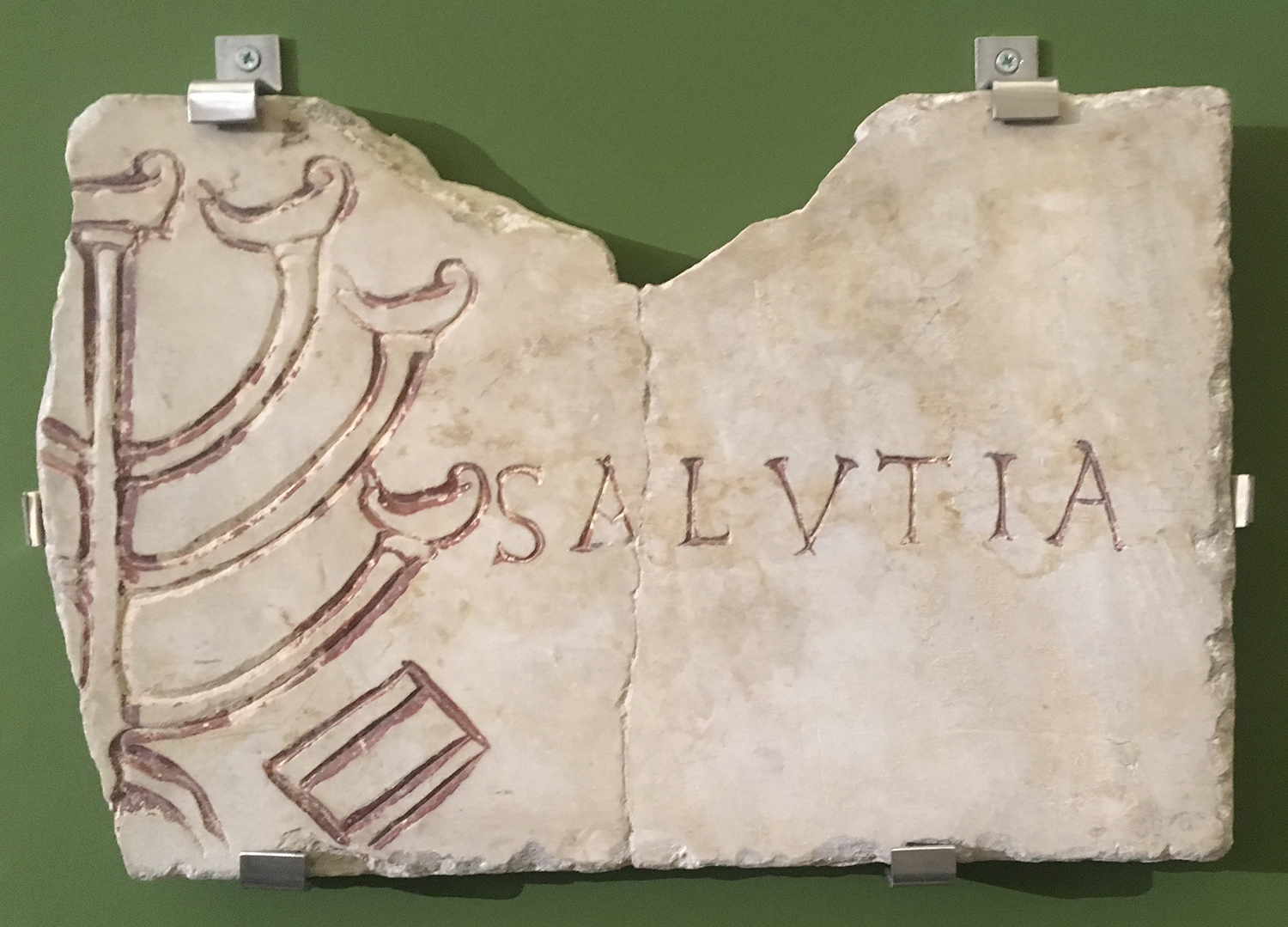
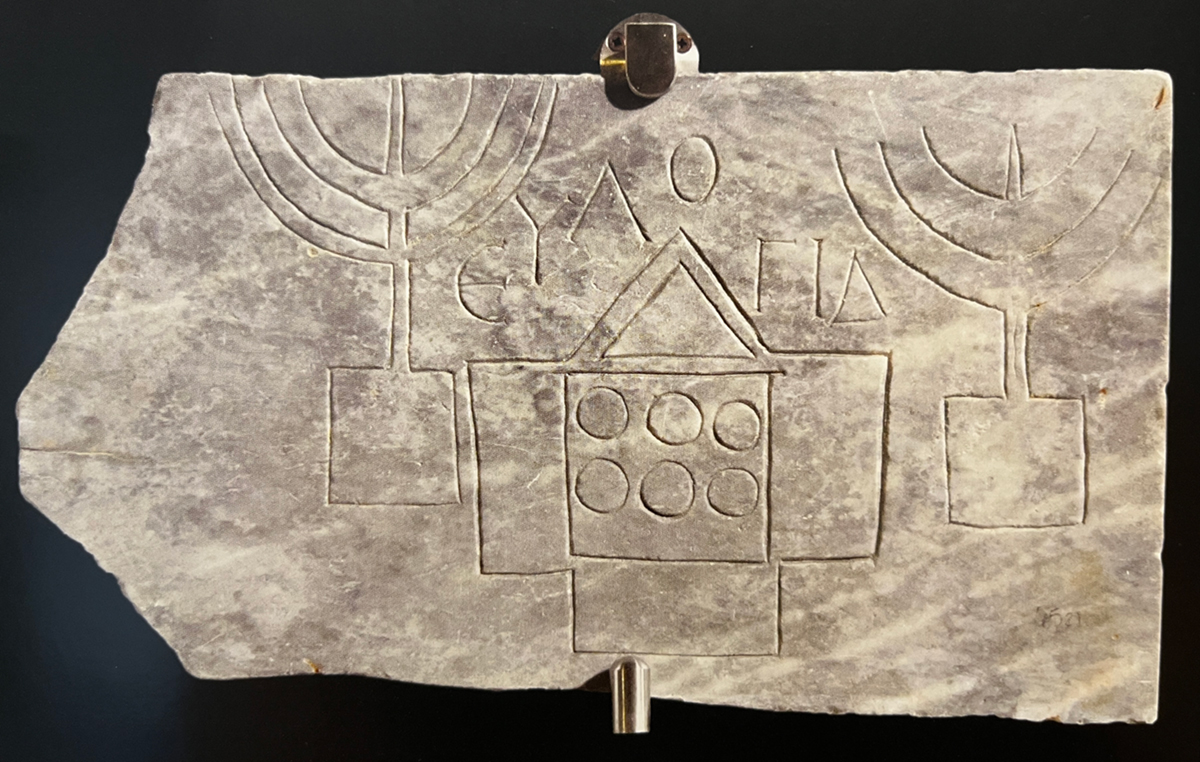
Another very interesting item in the epigraphic collection at the Baths of Diocletian in Rome is a portion of a sarcophagus that contains a nice depiction of a menorah. It is typically assigned to the third or fourth century CE, and it is often used as an illustration in books.

Sarcophagus panel with menorah; Museo Nazionale Romano, Terme di Diocleziano, inv. 67611; image Brent Nongbri 2026

The slab is positioned in a spot that is not on the main walking path in the museum and is easily missed. It is also positioned near a wall, which is a shame, because the back of the slab is also inscribed and is somewhat difficult to see in its current position:

Back side of a sarcophagus panel with menorah; Museo Nazionale Romano, Terme di Diocleziano, inv. 67611; image Brent Nongbri 2026

It is clear enough that this is a floor panel from a church, and googling the legible part of the inscription turns up Vincenzo Forcella’s 1874 edition of the inscriptions from the church of San Lorenzo in Damaso in Rome, among which is this one:

FRANCISCO DE BELLO
MEDIOLANESI MERCATORI
INTEGERRIMO QVI
VlXlT ANNOS L.
IO. ANDREAS DE MARCHESIIS MEDIOLANĒ
B. M. P.

The inscription, dedicated by one Milanese to another, is said to date to the 16th century, and the source is listed as “Dal Galletti (Cod. Vat. 7911, c. 17, n. 76),” that is a volume of clippings from the records of Pierluigi Galletti (1722-1790), who recorded many church inscriptions. Happily, this manuscript has been digitized by the Vatican Library.

De Bello’s inscription is also mentioned in a 1729 publication on San Lorenzo in Damaso by Giovanni Battista Bovio. If Bovio and Galletti saw Francisco de Bello’s slab in situ in the church in the eighteenth century, then it would have probably been removed during one of the substantial nineteenth-century interventions in the church. The slab was known to be a part of the Kircher collection at least as early as 1879, when it appeared in the guide to the museum written by Ettore de Ruggiero (1839-1926), and it was probably in the Kircheriano as early as 1866, when it was mentioned by Raffaele Garrucci (1812-1885). It passed into the Terme collection when the Kirchner collection was dispersed in 1915.

I’m not aware of other cases of Christian reuse of Jewish funerary art in exactly this way. I would be grateful to learn of more examples.

Posted in Judaism, Kircheriano, Museums, Raffaele Garrucci | Tagged , , , , | 1 Comment

Inscriptions of a Doctor and Historian

During a recent visit to the Museo Nazionale at the Baths of Diocletian in Rome, my attention was caught by a funerary urn made from a type of stone with very interesting patterns [[Update 27 Feb. 2026: I am informed that the stone is astracane dorato (castracane), a north African marble.]]

Funerary urn of the physician Claudius Melito, Museo Nazionale Romano, Terme di Diocleziano, sala VIII, inv. 115187; image Brent Nongbri 2026

The inscription on the urn is also remarkable:

Ti(beri) Claudi Athenodori f(ilii) Qui(rina) / Melitonis / Germanici medici1

Of Tiberius Claudius Melito, son of Athenodorus, of the tribe Quirina, doctor of Germanicus

The label in the museum identifies the “Germanicus” of the inscription as the general Germanicus (15 BCE–19 CE), father of Caligula, which seems reasonable (though Herbert Bloch seems to have understood the title to refer to the emperor Claudius, i.e. Tiberius Claudius Caesar Augustus Germanicus, 10 BCE–54 CE2). The label also connects the physician Claudius Melito to a reference in Galen, which seems a bit less certain to me. Galen just briefly mentions a “Melito” who was said to be the author of a medical recipe (ξηρὸν σηπτὸν τὸ Μελίτωνος, De compositione medicamentorum per genera, Kühn xiii 843).

The inscription was found in 1934 along the Via Praenestina (200 meters beyond the 8 km mark). The original publication also mentions another inscription found together with the urn of Claudius Melito. This piece is also now on display in the Baths of Diocletian but in the didactic area near the entrance:

Funerary stele the historian Claudius Herma, Museo Nazionale Romano, Terme di Diocleziano, inv. 115188; image Brent Nongbri 2026

The inscription is a bit more legible in the drawing published in the original edition:

Ti(berius) Claudius Herma / qui Sideropogon / appelatus est histo/riarum scriptor

So, this is the funerary stele of the Claudius Herma, a writer of histories who is called “Iron beard” (a latinization of what must have been a Greek name, σιδηροπώγων, but which is, as far as I know, not attested).

It is interesting to see these two Tiberii Claudii found together, a medicus and a scriptor historiarum, two people of learned professions probably buried in the same tomb.

  1. G. Iacopi, “Nuove iscrizioni di Roma e del suburbio,” Bulletino della Commissione archeologica del Governatorato di Roma 67 (1939) 13-26. This is the original edition of the inscriptions and also the source of the two drawings in this post. ↩︎
  2. H. Bloch, review of L’Année Épigraphique: Année 1940 in American Journal of Archaeology 49 (1945) 627-629. ↩︎
Posted in Baths of Diocletian, Inscriptions | Tagged , , | 2 Comments

The Recette de Saint-Remi and the Layout of an Early Greek Parchment Codex

As 2025 comes to a close, one last article is coming out:

“Mise-en-page Between Roman Egypt and Medieval Europe: The Recette de Saint-Remi and the Layout of an Early Greek Parchment Codex (P.Ant. 1 27),” Fragmentology 8 (2025), 155-169.

This article (available open access!) originated from a survey of the manuscripts usually regarded as the earliest non-Christian codices. There are a number of interesting things to observe in the corpus, but one item that stood out to me was P.Ant. 1 27 (TM 59621), a nicely preserved parchment folium containing a portion of Demosthenes, De corona. The original editors (C.H. Roberts and J.C Dancy) had assigned it to the third century, but it had more recently been reassigned to the second century.

Roberts and Darcy commented upon the layout of the text in two neat columns with wide margins: “The total effect is thus that of a spacious and well-proportioned page.” In fact, the layout of this manuscript aligns shockingly well with a set of somewhat idiosyncratic instructions for laying out a page preserved in the margins of a medieval Latin manuscript (BnF Latin 11884). The manuscript dates to the late ninth century, and the marginal addition, the so-called Recette de Saint-Remi, was probably added in the tenth century.

P.Ant. 1 27 with the layout suggested in the Recette de Saint-Remi superimposed

This similarity between the layout of P.Ant. 1 27 and the recipe has some important implications: Either this recipe for laying out the page has very early roots and the technology of the parchment codex had already reached a highly developed state by the second century, or P.Ant. 1 27 has been assigned a date that is perhaps a bit too early. The article contains an investigation of the dating of this codex, which turned up some fascinating details about the archaeological context of the papyri excavated at Antinoopolis during the Egypt Exploration Fund campaign of 1913-1914. This in turn led to a series of interesting discoveries relating to the Antinoopolis papyri that I will outline in a couple other articles that will hopefully be out soon. A good new year to all!

Posted in Antinoopolis Papyri, Archaeological context, Palaeography | Tagged , , , | 1 Comment

Augustine in the Cairo Genizah

Thinking about the letters of Augustine reminds me of one of the more interesting manuscripts I encountered this year. Among the many remarkable manuscripts in the Cairo Genizah is Cambridge University Library ADD.4320. It’s a collection of fragments of a palimpsest with an upper text containing masoretic notes on various texts from the Hebrew scriptures and a lower erased text that has been identified as a collection of Augustine’s sermons.

Cairo Genizah palimpsest with sermons of Augustine; Cambridge University Library ADD.4320a; image source: University of Cambridge Digital Library

The hand of the Latin script is a clear uncial that has been assigned to the sixth century, making these folia some of the oldest surviving copies of Augustine’s writings.

Cairo Genizah palimpsest with sermons of Augustine, detail of lower Latin text; Cambridge University Library Add. MS. 4320a; image source: University of Cambridge Digital Library

The bookmaker who reused the parchment from the codex of Augustine’s sermons seems to have just cut the bifolia in two down the middle, rotated the resulting folia 90 degrees, and folded them in half to make the new quires.

An open-access article by Hugh Houghton from 2019 provides a fresh treatment of the fragments and supplies the relevant bibliography. Houghton also poses a couple very interesting questions:

“How did a luxury codex of Augustine’s writings come to be reused some three or four centuries later for writing Hebrew masoretic lists before being deposited in the genizah in Cairo? Might still more pages come to light from the same document?”

The codex of Augustine’s sermons is one of several unambiguously “Christian” books that were found in reuse among the genizah fragments (that is to say, the content of the books was Christian, even if the last owners or users of the books did not identify as Christian). These include folia containing a lectionary with gospel readings, folia containing Acts and 1 Peter, and a leaf of Origen’s Hexapla.

It’s not hard to imagine that any serious scholar of the Hebrew Bible in medieval Cairo (Jewish, Christian, Muslim, or “other”) would be happy to have a copy of the Hexapla for consultation. But the exact reasons for someone in the Jewish community having a copy of Acts and the Catholic epistles in Greek or a collection of Augustine’s sermons in Latin is less easy to discern. It’s a reminder of how much we still don’t know about the Jews of medieval Egypt despite the wealth of evidence provided by the Genizah finds.

Posted in Cairo Genizah, Palimpsests, Reuse of manuscripts | Tagged , , | 1 Comment

Practicalities of Letter Delivery in Antiquity

When I teach about ancient letter writing, one of the things I emphasize is the precariousness of sending letters any great distance in the Roman world. Without an organized postal service, the delivery of letters could be quite haphazard. I just came across a very nice illustration of that point that had escaped my notice until now. It occurs in one of Augustine’s letters to Jerome written in the year 403 (Augustine, Letter 71, Jerome, Letter 104):

“And so, since I already sent two letters, but afterward received none from you, I chose to send the same letters again in the belief that they have not arrived. Even if they did arrive and your letters rather were perhaps unable to reach me, send once again those letters that you already sent if you perhaps kept copies. If not, dictate again something for me to read, provided that you do not, nonetheless, delay to answer this letter because it has already been a long time that I am waiting for it.”1

Most of this letter is dedicated to a fascinating discussion of Jerome’s text-critical activities and their contemporary reception, but this side note about the sending and receiving of letters raises some interesting questions about “original copies,” duplicate copies of letters sent to others, and the possibility of having to dictate an entire letter again.

BnF Latin 1868, fol. 192v; image source: Gallica
  1. “Quia ergo duas iam epistulas misi, nullam autem tuam post ea recepi, easdem ipsas rursus mittere volui credens eas non pervenisse. Quod si et pervenerunt ac fortasse tuae potius ad me pervenire minime potuerunt, ea ipsa scripta quae iam misisti iterum mitte, si forte servata sunt; sin minus, rursus dicta quod legam, dum tamen his respondere ne graveris, quod iam diu est ut exspecto!” K.D. Daur, Sancti Aurelii Augustini: Epistulae LVI-C (Brepols, 2005), p. 36; English translation by Roland Teske, The Works of St. Augustine: A Translation for the 21st Century: Letters 1-99 (New City Press, 2001), p. 266. ↩︎
Posted in Ancient letters | Tagged , , | 6 Comments

A Late Example of the Biblical Majuscule

When I think of the Biblical Majuscule, what usually comes to mind is the script of the famous Greek Bible, Codex Sinaiticus, which is usually assigned to the fourth century (though the early fifth is not out of the question). But as Guglielmo Cavallo demonstrated in his classic 1967 study, Ricerche sulla maiouscola biblica, examples of this script persist until the very end of the eighth century and perhaps beyond. I recently had occasion to look into a very late example of the Biblical Majuscule, and I find myself a little confused.

It involves one of the “new finds” from St. Catherine’s Monastery in the Sinai, Sin. ΝΕ gr. ΜΓ 012, a fragmentary parchment bifolium that is usually said to be securely dated to 861/862 CE. The bifolium belongs to Sin. gr. 210, a gospel lectionary (ℓ844 in the INTF numeration). The bulk of Sin. gr. 210 was reported as missing in 1983, but it was photographed in Kenneth W. Clark’s microfilming project in 1949. The date given for the manuscript in the microfilm is eighth century, which seems sensible given the script of the codex (a sloping pointed majuscule). The challenge is that the date given in the colophon preserved in Sin. ΝΕ gr. ΜΓ 012 is said to be 861/862 CE, which would place the codex (and its scripts) squarely in the ninth century rather than the eighth. This manuscript would then be (to the best of my knowledge) the latest precisely dated example of the Biblical Majuscule (at present, I think the generally accepted latest securely dated example is Vat. gr. 1666, a codex containing the Dialogues of Gregory the Great with a colophon dating to 800 CE).

Here is an image of the page in question from Sin. ΝΕ gr. ΜΓ 012:

Sin. ΝΕ gr. ΜΓ 012; image source: D. Harlfinger et al., Specimina Sinaitica (Berlin, 1983), figure 1

But note that the date is partly (actually mostly) obscured by a hole. Here is an image:

Detail of dating formula in Sin. ΝΕ gr. ΜΓ 012; image source: D. Harlfinger et al., Specimina Sinaitica (Berlin, 1983), figure 1

The editors read the dating formula as:

έτους κόσμ[ου ἀπὸ ἀ]δὰμ /[ϛτ]ο / ·

The date is thus restored to /ϛτο, world year 6370. Based on the assumption that the world was created in September of 5509 BCE, the equation would be 6370–5509 = 861 CE (or maybe 862, since we can’t read the month in the colophon). I can see and accept the omicron (70) for the decade digit, and the millennium digit logically must be a digamma (6000), but the crucial number, the century digit, is completely missing due to the hole in the manuscript. I’m not sure if there is anything else about this codex that would determine that the letter/number to be supplied in the lacuna must be tau rather than sigma, which would give us a date of 761 (or 762) CE.

One issue that may be problematic for restoring a sigma is that 761/762 would be, as far as I know, the earliest example of a precisely dated Greek colophon. At present, I believe the earliest example is again, Vat. gr. 1666, which is dated to April 6308 = 800 CE). So the Sinai codex would either be the earliest precisely dated Greek colophon or the latest example of the Biblical Majuscule, depending on whether we restore a sigma or a tau. Either way, an important milestone.

So, the manuscript is securely dated, in a sense (either 761/762 or 861/862 CE). The INTF Liste describes the date as “861/62?” I wonder if this is the reason for the question mark.

Posted in Biblical Majuscule, Palaeography, Scripts | Tagged , , , | 3 Comments